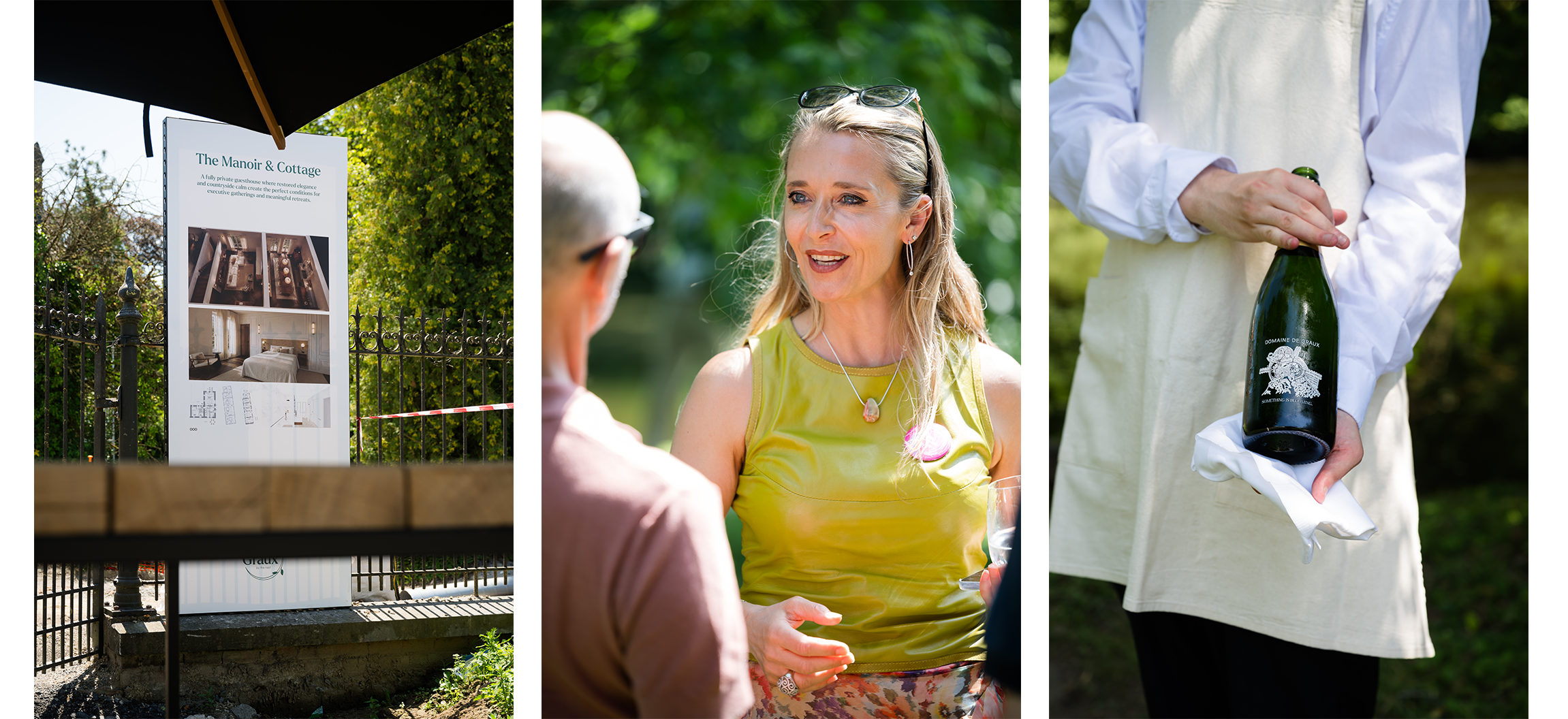
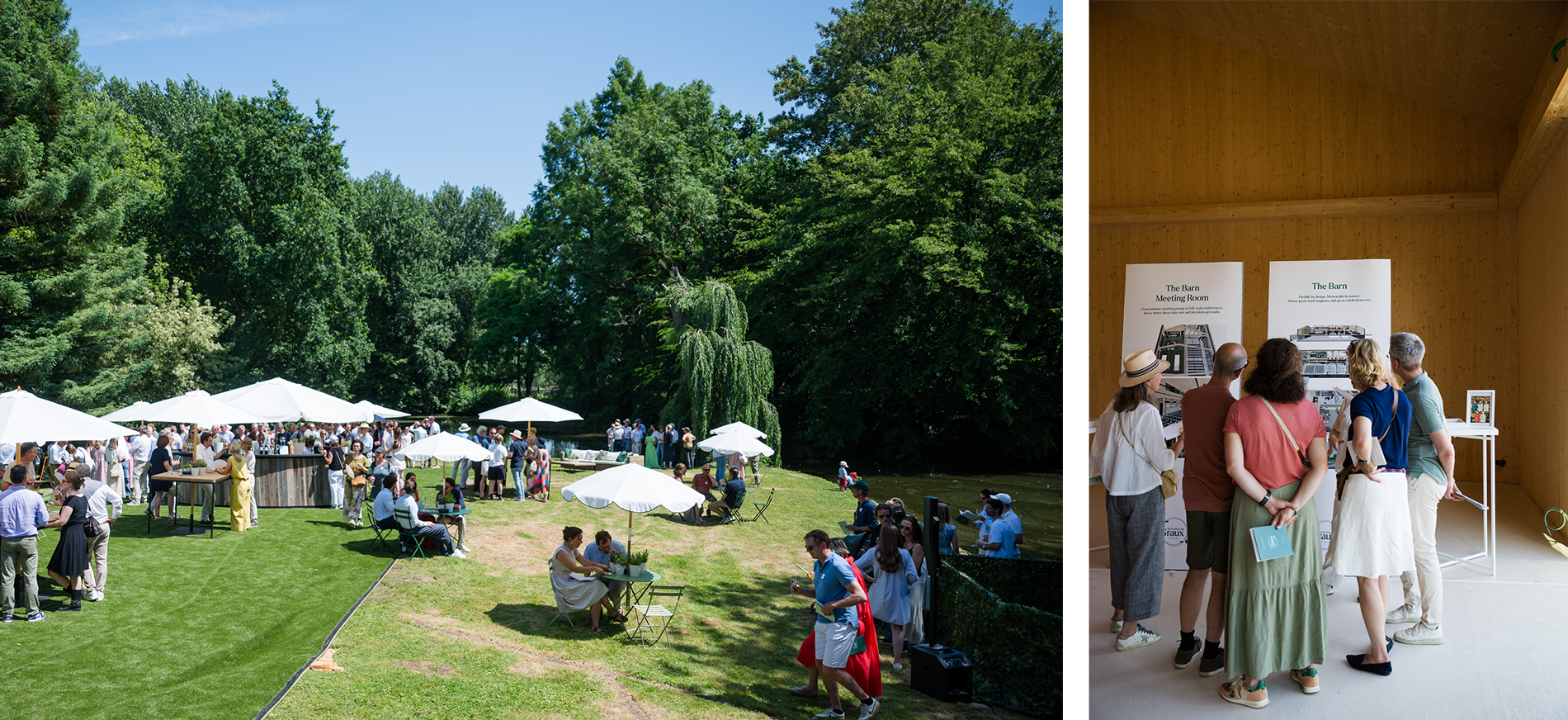
On June 20, the day of the Summer Solstice, The Nest and Domaine de Graux invited our community to the farm to see, not a finished project, but the work and vision in progress. That vision is grounded in the conviction of our founder, Els Thermote.
“Healthy soil grows healthy food, healthy food supports healthy people, and healthy people build healthy communities,” she explained. The future of Domaine de Graux is a working farm that proves agriculture can regenerate both the land and the community. A place where we can experience and engage with a healthy food system, with nature, each other, and ourselves as well.
Els spoke of our responsibility to recognize the storied history of the farm, built in 1492, and of as stewards of a future that will endure for generations to come. “We do not see ourselves as owners of this land. We see ourselves as temporary caretakers with the responsibility to leave it better than we found it,” she said. Read her speech here.
We are grateful to all who joined us for the event. We are even more excited now to welcome everyone when the farm reopens in January 2027 as a place for research, innovation, learning, and connecting. Together, we will make Domaine de Graux bloom. Discover the aftermovie here.
If you are interested in our approach to sustainable renovation and development at Domaine de Graux, please read our latest project update on the construction.
ROOTED Magazine
We also celebrated our solstice day event with the launch of ROOTED, a magazine that explores how we grow food while caring for the land and future generations. Explore the full issue here.
The magazine transparently shares the impact from The Nest’s investments and is designed to engage all in a conversation about our food system, our ecosystems, and our health. Learn why our founder Els Thermote decided to launch ROOTED.
From the Farm
Regenerative farmers offer the corporate world one of the most quietly radical ideas in decades: a system built to restore is more powerful, more resilient, and ultimately more productive than one built to extract.
In our latest article series from Domaine de Graux, we explain how these regenerative principles can also build better business leaders. Part 1 — What the Regenerative Farmer Knows That the CEO Might Have Forgotten, introduces the philosophy of rooted leadership and its four core disciplines.
The second article in the series, Part 2 — Lessons from the Farm: A Regenerative Playbook for Leaders, shares parallels between building soil health and the crop rotations of regenerative farming and responsible business leadership that supports the growth of diverse roles and individuals in an organization.
For organic week*, we shared our commitment to organic production since 2011 and how we build on that approach with bio-regenerative agriculture, short supply chains, and local sourcing.
*Bioweek/Semaine Bio is a Belgian initiative that aims to raise consumer awareness of organics by highlighting the benefits of organic food and production.
Food as Medicine Foundation
After three months of review of many deserving organizations, we have selected three projects for our “Health, from Soil to Stomach" call. Each project reconnects children with healthy, sustainable food:
- Le Ferme d’Anjou is on the edge of Brussels, they reconnect children with nature and with where their food comes from, through hands-on activities, sustainability education, and care for the animals and the land, made accessible to children who otherwise have little access to green spaces. Their new collaboration with La Ferme de la Tréflerie, an agroecological market garden, completes a holistic journey from soil to plate, turning children into stewards of the land.
- Plukgeluk offers camps and outdoor classroom education to children in Woonhaven and the District of Antwerp. Local schools come to Lekkeroever to learn about the ecosystem firsthand: tasting unfamiliar edible plants and discovering the urban nature around them. It's proof that any urban neighborhood can become a food and nature learning hub, right where children already live.
- Oxalis - Ecole de cuisine végétale, a plant-based cooking school launching a new program called 'Racines,' in partnership with L'École Comestible, a French non-profit that has already proven its impact through food literacy programs connecting every step of the food journey, from seed to compost to plate. Together, they bring this full journey into the classroom, not as a one-off, but as an ongoing trajectory.
Each project will receive support for three years, both funding and non-financial support that includes strategic coaching, access to our network, and a peer-to-peer learning space. We will share more updates on the organizations and our Health, from Soil to Stomach initiative in September.

Portfolio News
Agricarbon
Agricarbon completed baseline sampling of 53,000 soil cores across more than 5,000 fields as part of ADHB’s Environment Baselining Pilot. The project focuses on the beef and lamb, cereals and oilseeds, dairy and pork sectors in England, Scotland and Wales.
Ardo
Ardo’s site in Ardooie has been awarded the Voka Charter for Sustainable Entrepreneurship for the 23rd consecutive year.
Edacious
Through rigorous analysis by Edacious, regenerative dairy Alexandre Family Farms will become one of the first U.S. dairies to feature verified omega fatty acid balance claims on product packaging. The initiative marks a forward stride in improving nutrient labeling transparency.
LocalLine
LocalLine, a startup that offers supply chain software for local food sourcing, launched their updated website. The new content makes it easy to understand how their solution support food hubs, farmers, restaurants, grocers, and distributors.
Lowi
The Nest led a €2.7 million funding round in Hasselt-based start-up Lowi. Lowi is “common sense” AI designed to help small and mid-sized enterprises increase the efficiency of daily business processes and interactions with customers and suppliers. The solution does not incorporate autonomously acting agentic AI and is privately hosted in Europe.
Anyone committed to sustainable food must also commit to the systems that make it possible. The Nest Family Office invests specifically in impact-driven companies within agro and food, because we believe that process optimization and data insights are not a luxury in this sector, but a necessity. With this investment, we are building the digital backbone that supports a more sustainable food chain.
Steward
Steward’s latest successfully funded $20M loan will help Green Acres Milling, a farmer-owned oat mill, expand regenerative grain markets and local economies across the Midwest US.
Zymofix
Zymofix secured €1.9 million from VLAIO to support MicroFix, a €3.2 million collaborative research project with Ghent University. The research will explore the potential for Zymofix’s proprietary solid-state fermentation platform to deliver more predictable biological product performance.
Fund News
Blume Equity
Blume Equity, along with Ireland Strategic Investment Fund and Goodbody Capital Partners invests €49m in CameraMatics, an AI-powered video telematics and fleet intelligence platform.
Greensphere Capital
Greensphere will partner with the Smithsonian Institution to expand their Gaia Sciences Innovation Global Natural Sciences Platform. The landmark partnership unites British and U.S. bioscience institutions with Greensphere’s investment platform, Gaia Sciences Innovation. The partnership will focus on developing solutions for climate adaptation, biodiversity, agriculture, oceans and resilient global supply chains.
Pymwymic
Pymwymic co-led an €18m Series B investment in Stenon, a German AgTech company enabling efficient and sustainable nutrient management through real-time soil analysis. New investor DeepTech & Climate Fonds participated along with existing shareholders such as Atlantic Labs and Oyster Bay.
SP Ventures
São Paulo-based SP Ventures secured a $50 million second closure for its third agriculture-focused tech fund. SP Ventures’ portfolio solutions include biological inputs, financial services to farmers, and digitizing for agricultural supply chains. The Nest, along with IDB Lab, JICA, and global corporations like AGCO Corp. and BASF Venture Capital participated in the funding.
From the field: Groundswell UK
We recently visited Groundswell, the UK’s leading regenerative agriculture festival, where thousands of farmers, researchers, entrepreneurs, and investors come together to explore the future of food and farming. What stood out wasn’t just the innovation, it was the growing momentum. Regenerative agriculture is no longer a niche movement; it’s becoming a global community committed to restoring soil health, strengthening farm resilience, and producing better food. We left inspired by the collaboration, practical solutions, and shared sense of purpose.

An Introduction to Impact
At The Nest, we often talk about our systemic approach to investing. But what is systemic investing and how is it different from impact investing? As an introduction to the topic, we invite you to start with the article by Anouk Schoors, our investment director, on why systemic investing matters or our interview with The Nest's impact coordinator Johanna on the foundations of our impact measurement, both in ROOTED.
The resources below help define the concept and why it is essential to transform systems.
- “What is systemic investing, and why are impact investors taking notice?” an excerpt from the Investor’s Guide to Systemic Investing.
- “Systemic Investing for Social Change,” published by the Stanford Social Innovation Review.
What We Are Reading and Watching
Food is Medicine as a Climate Solution
We wholeheartedly believe in the value of Food is Medicine and its positive outcomes for healthier people. A new study highlights how Food is Medicine contributes to a healthier planet as well. Food is Medicine programs reduce greenhouse gas emissions by increasing the adoption of locally-sourced plant-based diets, reducing food waste, and reducing health care use.
Why invest in biotech?
Investing in biotech is a high-risk endeavor. Solutions can be costly, hard to develop, and fraught with regulatory and technical complexity. So why invest? Incubator biotope by VIP answers this important question transparently in their latest post.