


We’re four days into a story about change - about what it truly takes to build a better food system from the ground up. We began on the land, with Clear Frontier. We added knowledge, through Domaine de Graux and ColemBIO. And we introduced capital, thanks to Walden Mutual Bank and Steward.
Now, we arrive at a stage that often gets the least attention - but carries some of the highest stakes: The moment when crops leave the farm and enter the food system.
The point where purpose either becomes viable, or vanishes in the margins.
Farm for Good (FFG) Cooperative - Closing the loop
For many regenerative farmers, growing differently is only half the challenge. The other half? Selling differently.
That’s why the team behind Farm for Good launched their Cooperative.
Its mission: “To build the bridge between farmers and processors, so that food grown with integrity reaches the market at scale, fairly, and with shared value.”
Here’s the problem they’re solving:
Transitioning farmers often produce crops that exceed organic standards - richer in biodiversity, lower in inputs, better for the soil. But those crops are still priced, and treated, like commodity product. Meanwhile, food processors are facing growing risks: supply chain instability; price volatility; rising consumer demand for traceability and sustainability.
The system is simply not designed to recognize the value of a farmer who’s working in harmony with nature. The FFG Cooperative is redesigning that part of the system.
A new economic logic: Pay first, not last
Traditionally, farmers are the last to be paid. They harvest, they deliver, they wait (weeks or even months) before seeing cash. It’s a cash flow model that punishes the very people taking the risk.
The FFG Cooperative flips that script. They purchase crops as soon as they’re harvested, giving farmers immediate payment - and a clear, fair price agreed in advance. That financial certainty allows farmers to invest in their transition, plan for the next season, and operate from a place of stability, not scarcity.
You can’t ask farmers to change everything about how they grow - and then make them wait to get paid. Cash flow is the real engine of change.
Shared risk, shared commitment
Of course, supporting this kind of model requires more than just good intentions. It requires capital - the kind of patient, risk-tolerant investment that sees the long view.
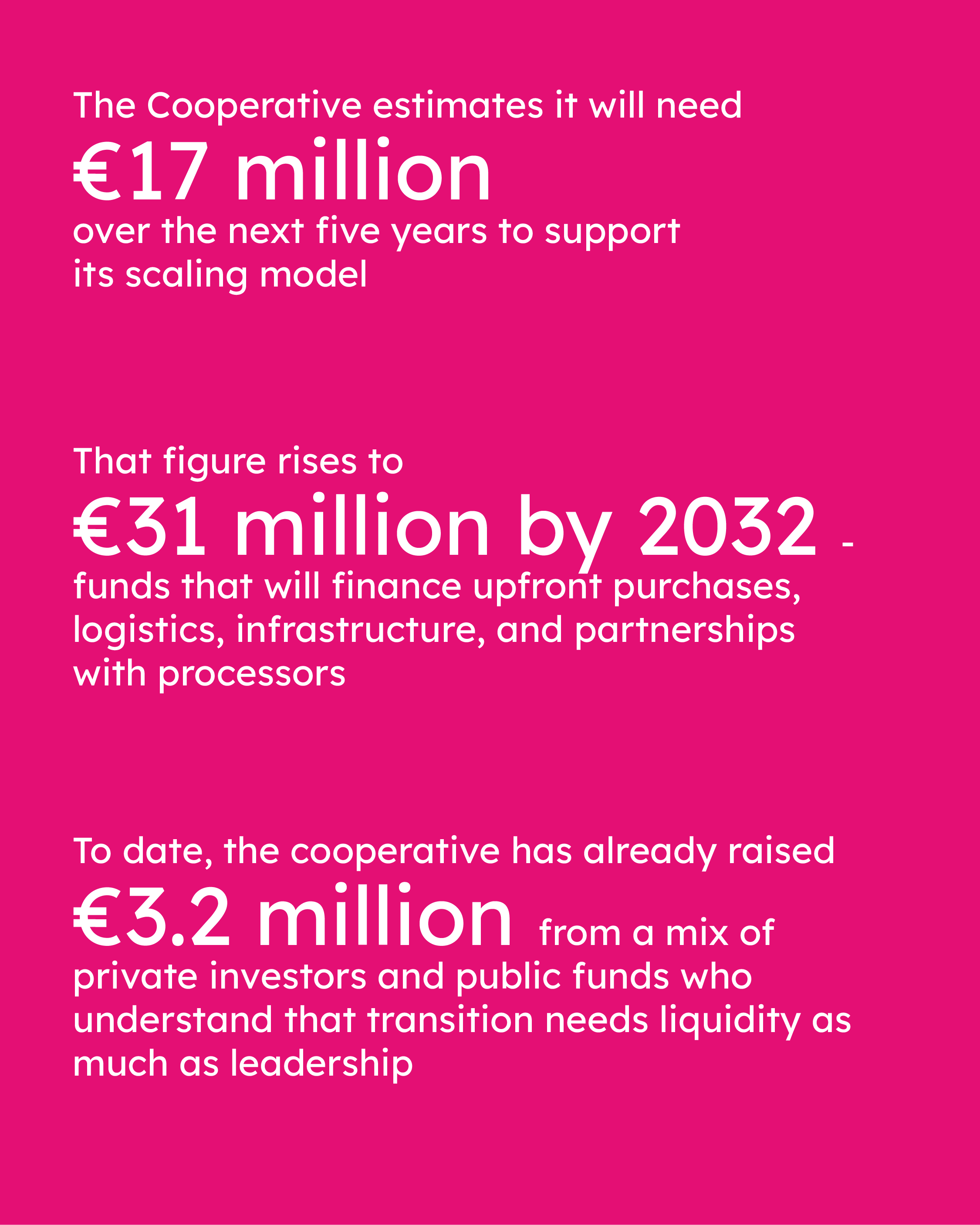
The numbers are clear. The Cooperative estimates it will need €17 million over the next five years to support its scaling model, primarily by securing the cash flow of its partner farmers. That figure rises to €31 million by 2032 - funds that will finance upfront purchases, logistics, infrastructure, and partnerships with processors.
To date, the cooperative has already raised €3.2 million from a mix of private investors and public funds who understand that transition needs liquidity as much as leadership.
And with each new round of investment, the goal is not just to grow volume, but to deepen transparency.
Aligning the chain
One of the most powerful things the FFG Cooperative is doing isn’t financial, it’s relational.
They’re restoring trust between the actors in the food system by:
- Aligning transformation partners on price - so everyone from farmer to processor shares the same financial logic and expectations
- Creating long-term contracts that reward consistency, collaboration, and ecological performance
This approach reduces volatility for all sides. It also turns one-off transactions into strategic partnerships, designed to evolve together over time.
In this model, everyone knows the rules. Everyone shares the risk. And everyone (finally) has a seat at the table.
If Chapter 1 gave us the land, Chapter 2 the knowledge, and Chapter 3 the finance - this chapter gives us continuity. This is the distribution layer. The link that ensures that what’s grown regeneratively doesn’t stop at the field gate - but makes its way into supply chains, markets, and meals. It’s also the layer where impact gets measured in margins.
Because if farmers can’t sell what they grow (or can’t sell it in a way that values their practices) the system simply doesn’t work. The Farm for Good Cooperative ensures it does.
And this isn’t just about crops - it’s about dignity. It’s about recognizing the true value of those working hardest to transform how we eat - and giving them the economic tools to keep going.
The Farm for Good Cooperative is fixing something foundational: the flow of value, back to its source.
Tomorrow, we conclude the story with Biotope Group, the final link between field and fork: access to consumers.