


Yesterday, we began our journey into the regenerative food system of tomorrow - one grounded in soil, resilience, and a fresh relationship to farmland. But land alone isn’t enough. The best soils in the world can only do so much without the people, and the knowledge, to cultivate them wisely.
In every system, the next critical layer is the know-how. And that's where today's chapter begins. Let us take you to two farms where history, experimentation, and transformation come together: Domaine de Graux and ColemBIO.
Old lands, new knowledge
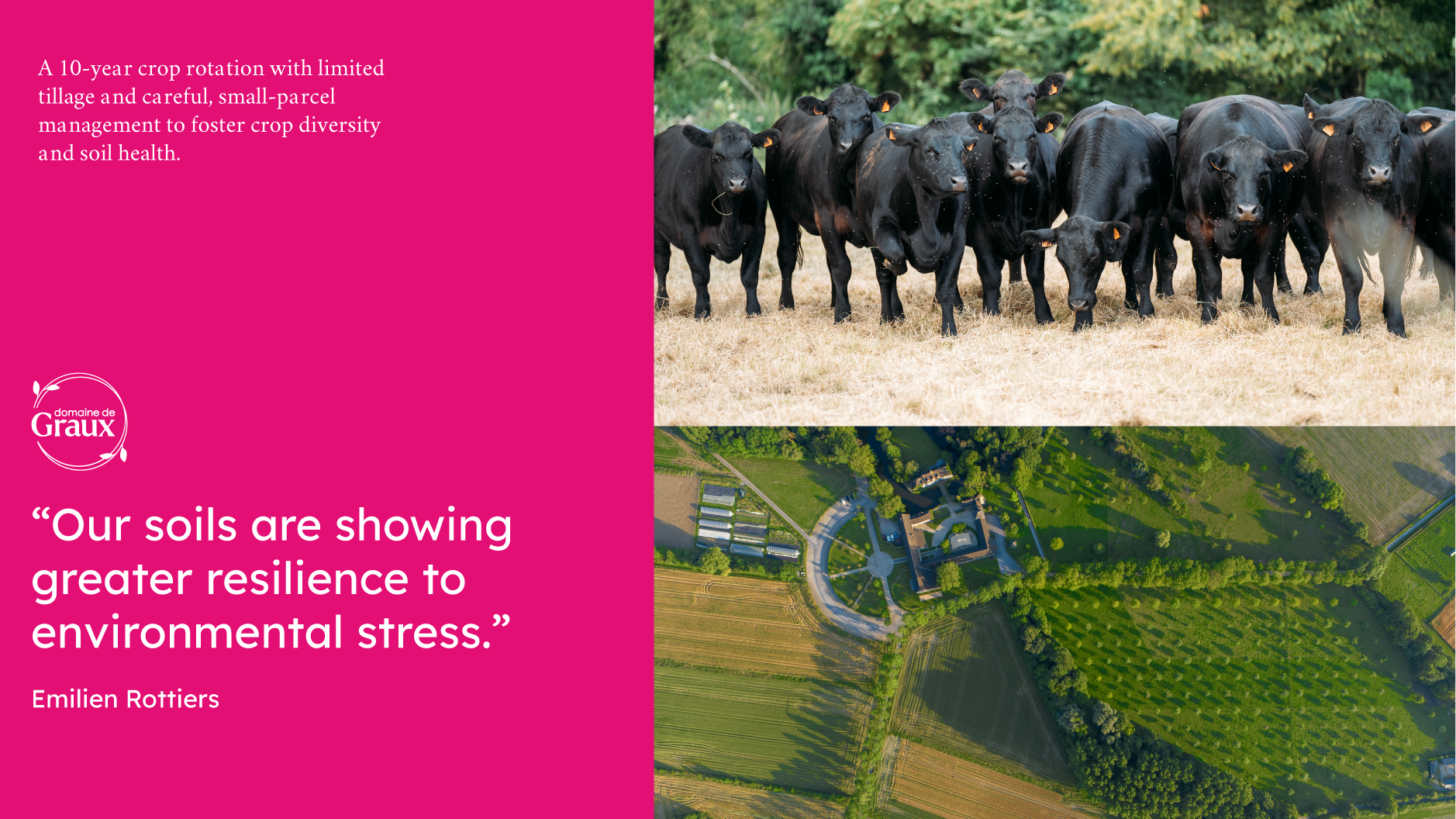
Set on 120 hectares (or 296.5 acres for our American readers) of rolling farmland, orchards, vegetable gardens, and grazing pastures, Domaine de Graux has been part of the landscape since the 1400s. But its most exciting chapter might be happening right now.
When acquired in 2022, Domaine de Graux was not at the start of its transformation. That work had already begun, thanks to its previous owner, Elisabeth, who laid the groundwork for a regenerative future. Instead, our goal was to recognize that legacy and to continue pushing it forward, prototyping the future of agriculture.
Together with on-the-ground farmers like Emilien Rottiers, we’ve turned Domaine de Graux into a living lab for agroecology - where practices are tested, refined, and scaled with real-world conditions in mind. Our ambition is clear: to demonstrate that agroecology and organic farming are not just viable, but effective at scale, and that such practices can feed communities, restore ecosystems, and reshape the future of agriculture.
“Our soils are showing greater resilience to environmental stress.” says Emilien.
How? A 10-year crop rotation with limited tillage and careful, small-parcel management to foster crop diversity and soil health.
And this mission goes even beyond farming. The farm is also evolving into a reference point for responsible event hosting, showing that sustainability can shape not only how we grow food, but also how we gather, celebrate, and connect.
Just 100 km away, another story unfolds at ColemBIO, where Simon Colembie, a 5th generation farmer, carries forward a legacy of quiet transformation. His father Geert Colembie began planting trees and hedgerows in the early 2000s, significantly reduced plowing, and introduced grass strips to prevent soil erosion - embracing regenerative practices long before it was a buzzword.
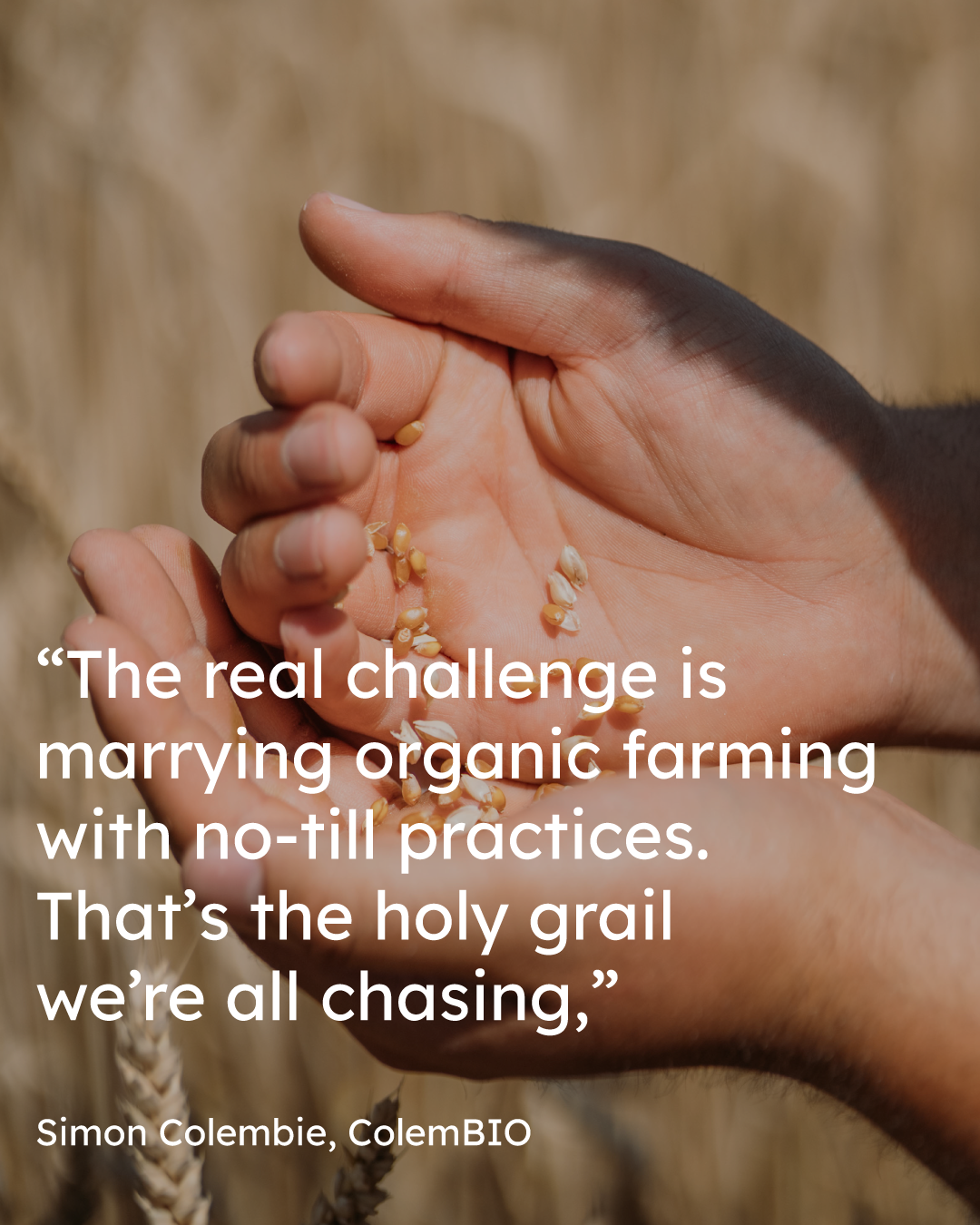
In 2016, Simon - who took over the farm in 2019 - and his father transitioned the farm to organic. Today, he is experimenting with intercropping, cover crops, and limited tillage - searching for the elusive balance between organic farming and soil protection.
“The real challenge is marrying organic farming with no-till practices. That’s the holy grail we’re all chasing,” says Simon.
More than farms: A hub for transition
These farms are more than places of production. They are:
- Knowledge centers connecting farmers, researchers, and innovators
- Training grounds for the next generation, where tradition meets adaptation
- Platforms for collaboration across the entire food value chain
Domaine de Graux is also the place where Agroecology Europe was founded in 2016, which now acts as a pan-European movement promoting sustainable food systems through science, education, and policy.
From field to fork, we’re showing how knowledge, when shared and applied, can accelerate transformation - farm by farm, meal by meal.
Why it matters
Without access to knowledge, the best land, tools, or intentions may fall short. Domaine de Graux and ColemBIO are places where knowledge comes alive, through the lived experience of farmers who never stop learning.
We believe the future of food is one that scales up by staying rooted - in place, in context, and in collaboration.
And as we move through the week, we’ll show how knowledge links with finance, markets, and access to create real systems change.
If Clear Frontier (in Chapter 1) offers the land, then Domaine de Graux and ColemBIO bring the knowledge: the know-how needed to unlock the land’s full potential, and to do so in a way that respects both nature’s limits and its genius.
In our aspirational food system, this chapter is the intelligence layer. It's the farmers learning not just how to produce, but how to regenerate. Tomorrow, we add another layer: finance. Because even with land and knowledge, transformation stalls without the right capital behind it.