


This week, we’ve traveled from farmland to financing, from knowledge-sharing networks to bold new business models. We’ve seen how land, know-how, capital, and offtake can form the early architecture of a radically different food system.
But a system isn’t complete until it reaches the people it was built to serve.
That’s where today’s story begins. With the final and maybe the most visible link: access.
Biotope Group - Making good food reachable
It’s one thing to grow regeneratively. It’s another thing entirely to get that food into people’s hands, homes, and habits.
Enters Biotope Group, a leading organic wholesale and retail network with a bold ambition:
"To make high-quality, organic food accessible - and to do it with transparency, fairness, and deep respect for the land and those who care for it."
With over 125 locations across Belgium and the Netherlands, Biotope Group isn’t just talking about system change - they’re operating it, every day, across shop floors and distribution centers.
Their structure is powerful in its simplicity. The combination of wholesale and retail ensures that efficiency meets intentionality. And their local roots ensures scale meets nuance.
Rethinking retail: Relationships before margins
Traditional food retail has a logic: prioritizing volume, minimizing cost, staying flexible, and switching suppliers often to find the lowest price.
But Biotope Group is turning that logic on its head. Instead of chasing the cheapest carrot, they focus on:
- Annual planning meetings with farmers
- Collaborative pricing and long-term purchasing agreements
- Support for transition, certification, and regenerative practices
This model offers stability for farmers - not just emotionally, but economically. When growers know what to expect, and are paid fairly, they can reinvest: in their soil, their tools, their staff, and their futures.
At Biotope, retail isn’t just about price or even product. It’s about principles.
Take their brand, Ekoplaza, for example - you’ll find signs on the wall that say things like:
- “Only the orange gets squeezed, not the grower.”
- “Soil life is more important than rock-bottom prices.”
- “Everything tastes like it naturally tastes.”
- “No artificial preservatives. No palm oil. No microplastics.”
These aren’t marketing slogans - they’re operating choices. Ekoplaza ensures fully transparent supply chains, proposes twice as many vegetarian options as animal protein-based options, and supports small-scale producers.
Another Biotope brand, Färm, shows what happens when local meets scale.
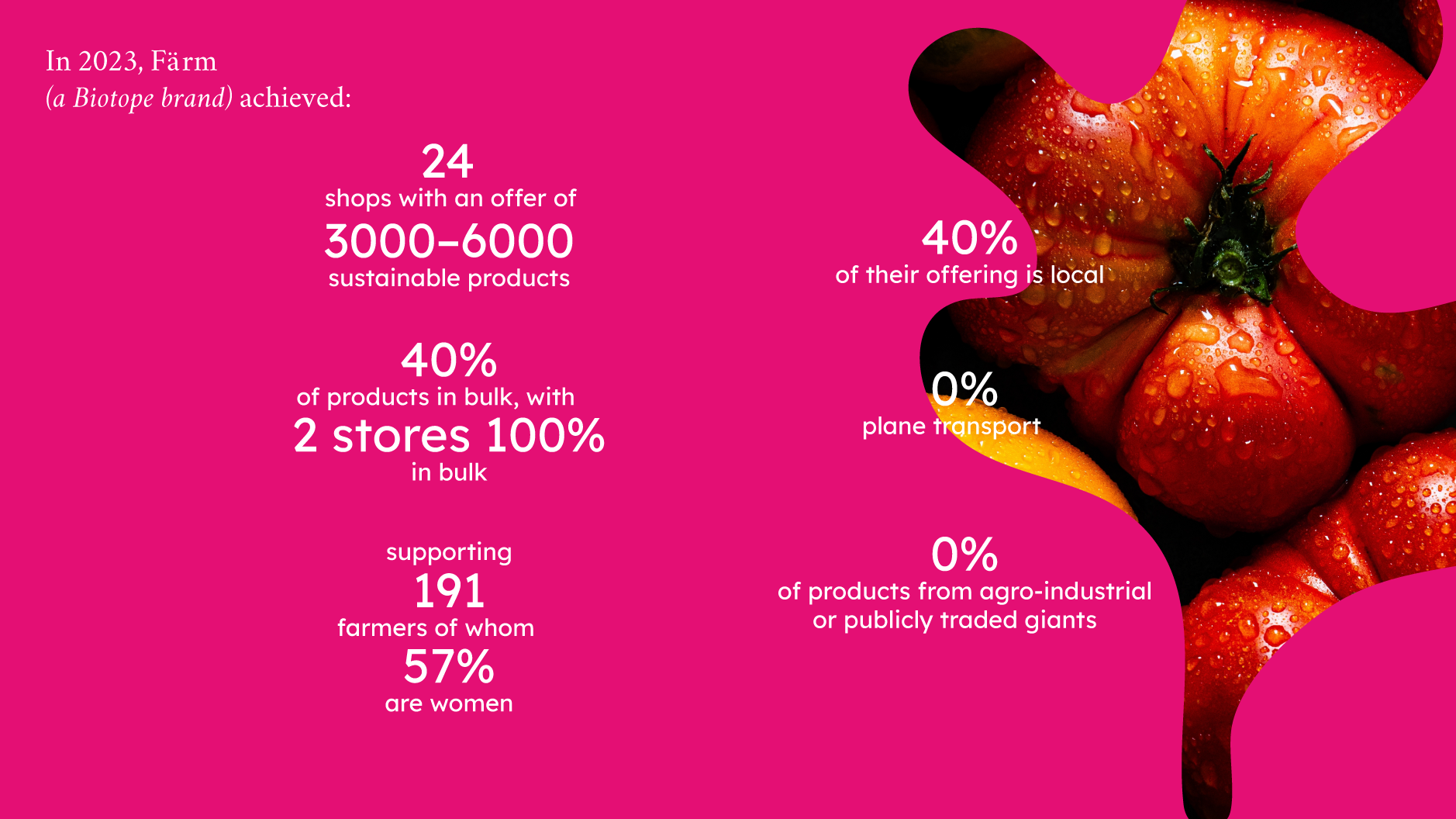
In 2023, Färm achieved:
- 24 shops, with an offer of 3 000 - 6 000 sustainable products (which today increased to 40 shops!)
- 40% of products in bulk (with 2 stores 100% in bulk!)
- Supporting 191 farmers - 57% of whom are women
- 40% of the offering being local
- 0% plane transport
- 0% of products from agro-industrial or publicly traded giants
These two brands show examples of retail that don’t exploit scale - but uses it strategically, to reduce costs without compromising values. It also makes it easier to educate consumers and foster long-term habits around seasonal eating, healthy food, and ecological literacy.
In our story, Biotope Group represents the distribution layer - the critical infrastructure that delivers regeneratively grown food into everyday life.
Without it, the system is incomplete. Without it, even the best soil practices and most ethical finance models remain niche.
Biotope Group ensures:
- Farmers get long-term markets
- Consumers get real choice and quality
- The entire chain is transparent and resilient
They are the connective tissue - where food values become food access.
Wrapping up: A system within reach
This week wasn’t just a showcase - it was a blueprint. Each company or initiative we highlighted plays a unique role in fixing a broken food system. But more importantly, they show what happens when these roles connect:
- Clear Frontier gave us the land - and a way for soil health to fuel climate resilience.
- Domaine de Graux and ColemBIO gave us the knowledge - a blend of tradition and experimentation rewriting the rules of resilience.
- Walden Mutual Bank and Steward gave us finance - and reminded us that where we place our money shapes what grows.
- Farm for Good Cooperative gave us offtake - turning regeneration into reliable revenue.
- Biotope Group gave us distribution - a trusted route from soil to shelf.
Together, these aren’t just five stories. They form the foundations of a new food system - small in scale, big in implication. A system where transformation is possible, profitable, and already in motion.
The real impact of this week isn’t measured in likes or reach. It’s measured in the decisions we make as investors, consumers, and citizens.
We’ve seen that by identifying and addressing key bottlenecks - in land access, knowledge sharing, capital flow, supply chain structure, and consumer access - we can unlock the full potential of a regenerative food future.
The question is no longer if we can do this. The question is: "how fast, and how far, are we willing to go?".
The journey doesn’t end here. We invite you to connect with us or explore more stories, insights, and updates in our Journal section.