


In response to decades of industrial agriculture, a growing number of alternative farming practices are emerging. Regenerative agriculture, organic production, agroecology, conservation farming: each presents itself as a pathway toward healthier soils, richer biodiversity, and more resilient food systems. These approaches aim to counteract the environmental and social costs of intensive, large-scale production. Yet as these models multiply, so do the labels, claims, and certifications attached to them. The legislative frameworks remain complex and, at times, ambiguous. For consumers who want to make empowered, healthy, and environmentally responsible choices, navigating this landscape can feel increasingly overwhelming. What truly differentiates one practice from another? Which claims are regulated, and which are marketing language?
How to Read the signs
One of the best ways to understand these labels and what different production practices mean for your food is to engage directly with growers and producers at a farmers’ market. Not only will you find the best heirloom tomatoes in July, but you can also learn to navigate our complex food system. Like many journeys, the discovery starts with a sign. Market signage boasts everything from practices to sourcing, certifications to philosophies. Unlike labels at a grocer, the producers are present at the market to explain their practices.
Booths with signage claiming “regional” and without production information are much like unlabeled conventional produce at the grocery store. The sellers grow little to none of the produce they sell and are often reselling from wholesale sources. At the grocery store scale, purchases of produce in bulk from suppliers should align with food safety standards, including legal use of pesticides. Whether sourced from a store or a farmers’ market or commodities in bulk, conventional products are generally produced using synthetic pesticides and fertilizers and intensive practices. At scale, conventional agriculture practices are associated with ecosystem impacts, or externalities, including soil degradation, water pollution, biodiversity loss, greenhouse gas emissions, and weakened rural livelihoods.
Certified Organic as an Internationally Recognized Standard
A few of the booths at the farmers’ market display the USDA or EU organic seal. If a farm is not certified organic, displaying the organic seal, or referring to produce as organic would be a violation of the law, provided the farm generates over a specified amount in gross income per year from organic sales. Organic is a regulated label claim, with the final rule establishing the US National Organic Program published in the US Federal Register in 2000. The standard is recognized and shared by other countries, including the EU, UK, and Canada.
If you ask certified organic farmers why they chose this method of production, their first response usually focuses on not using chemicals like synthetic pesticides and fertilizers. Their other typical response is “non-GMO,” a reference to genetically modified organisms. Consumers share the same concerns, citing “free from pesticides” as their main reason for choosing organic, according to a 2024 Organic Trade Association (OTA) survey with 2,522 US consumers.
Beyond restrictions on inputs, organic regulations require certified operations to produce food in a way that maintains soil health and water quality. Organic standards require the use of cover crops and crop rotations, and require grazing/pasture time for livestock (NOP, 2025). The underlying philosophy is one of protecting the ecosystem and preventing harm.
What is Regenerative?
A newer sign above market booths reads “Regenerative.” Regenerative livestock farms may sell meat and eggs produced in a rotational grazing system. Rotational grazing is sometimes referred to as “carbon farming” as these practices increase soil organic carbon, soil health, and soil biodiversity.
Regenerative farming encompasses a wide range of practices by operation, crop, product, and region with a shared goal of restoring and improving soil health, water quality, and ecosystem services. The Regenerative Agriculture Initiative (2017) defines four foundational attributes of regenerative farming that should apply to all truly regenerative farms:
- Contribute to generating/building soils and soil fertility and health.
- Increase water percolation, water retention, and clean and safe water runoff.
- Increase biodiversity and ecosystem health and resiliency.
- Invert the carbon emissions of agriculture from a net source to a net sink with significant carbon sequestration.
The US Department of Agriculture (USDA) provides a practice-based interpretation of regenerative agriculture, with five key principles (GovFacts, 2025):
- Minimize Soil Disturbance (Physical, Chemical, Biological).
- Maximize Soil Cover (“Soil Armor”).
- Maximize Continuous Living Roots.
- Maximize Biodiversity (Above & Below Ground).
- Integrate Livestock (Thoughtfully).
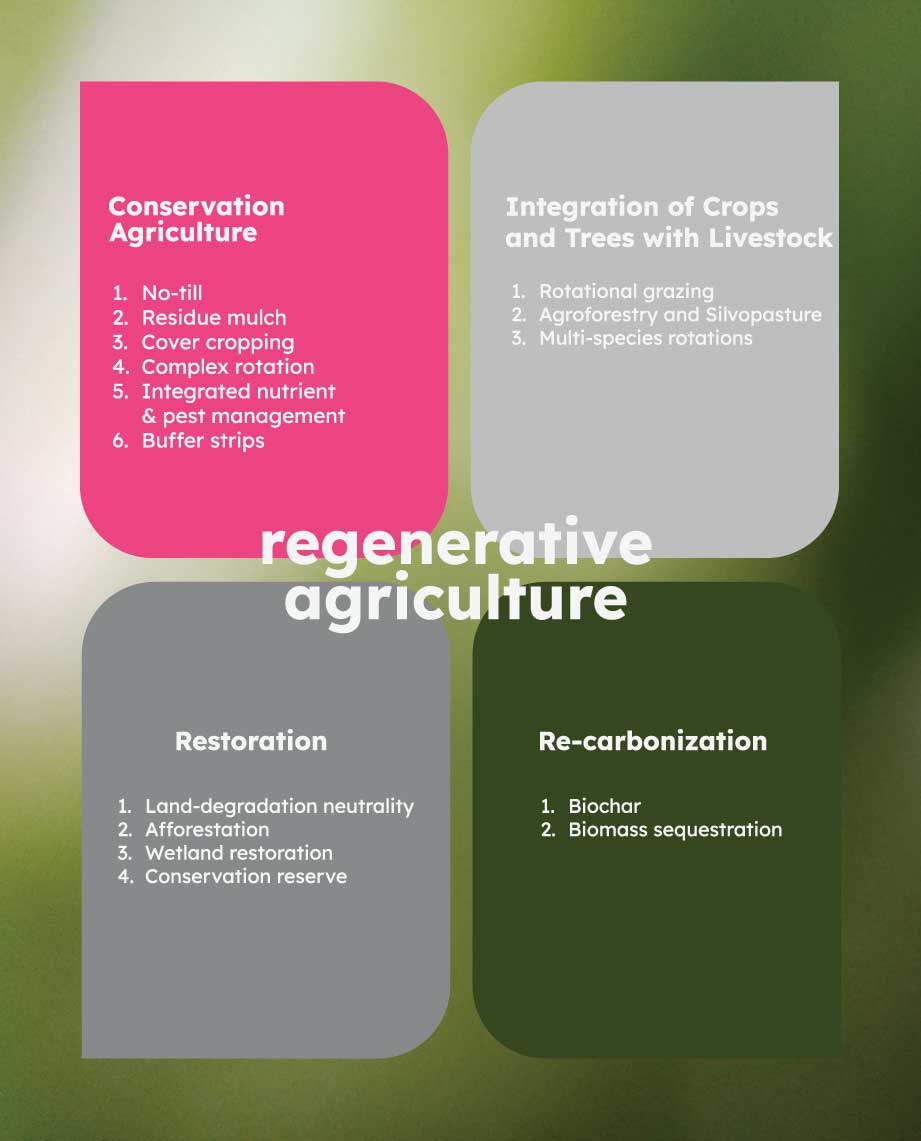
The most unifying principle, however, is the focus on outcomes-based regeneration, which is critical at a time when we have exceeded six of the earth’s nine planetary boundaries (Caesar et al., 2025), including the predicted degradation of the 90 percent of arable soils by 2050. “Maintaining” the status quo is no longer an option. Regenerative agriculture, at its best implementation, seeks to help restore the planet’s critical balance. Subsets of regenerative farming practices are sometimes described as restoration agriculture, conservation agriculture, or the more limited climate-smart practices that focus on reduced tillage, inputs, and cover crop use.
What about Agro-ecology?
Sustainable farms in the EU are more likely to describe their practices as agro-ecological than regenerative. Agroecology is a framework that seeks to transform food systems. The framework is based on three pillars: 1) sciences of agronomy and ecology, 2) a set of practices, and 3) a social movement of participation, local connection, farmer empowerment, and fairness and justice. Agroecology focuses on the rebuilding of relationships, whether that relationship is synergy between plant-soil-animals-water, farm and surrounding ecosystem, or farmer and consumer.
Subsets of the agro-ecological framework include conservational agriculture and organic conservational agriculture. Conservational agriculture, like the US “conservation agriculture,” centers on protecting soil and water resources with practices like minimal tillage, cover cropping, crop rotation, reducing inputs, and residue retention. Organic conservational agriculture builds on this by prohibiting synthetic pesticides, herbicides, and fertilizers, adding a human health dimension.
Organic Versus Regenerative at the Practice Level
Organic and regenerative systems share many of the same practices despite the different philosophies. Because regenerative is not standardized, it is hard to define and claims are subject to debate. A review of no-till conventional agriculture, non-certified regenerative practices, and the standards for certified regenerative, organic, and regenerative organic (a certification based on USDA certified organic plus verified regenerative practices) highlights key differences in how these systems may be implemented, below. Areas highlighted in green represent the most significant differences. Grey highlights are areas where practices varied widely by program or have more uncertainty.
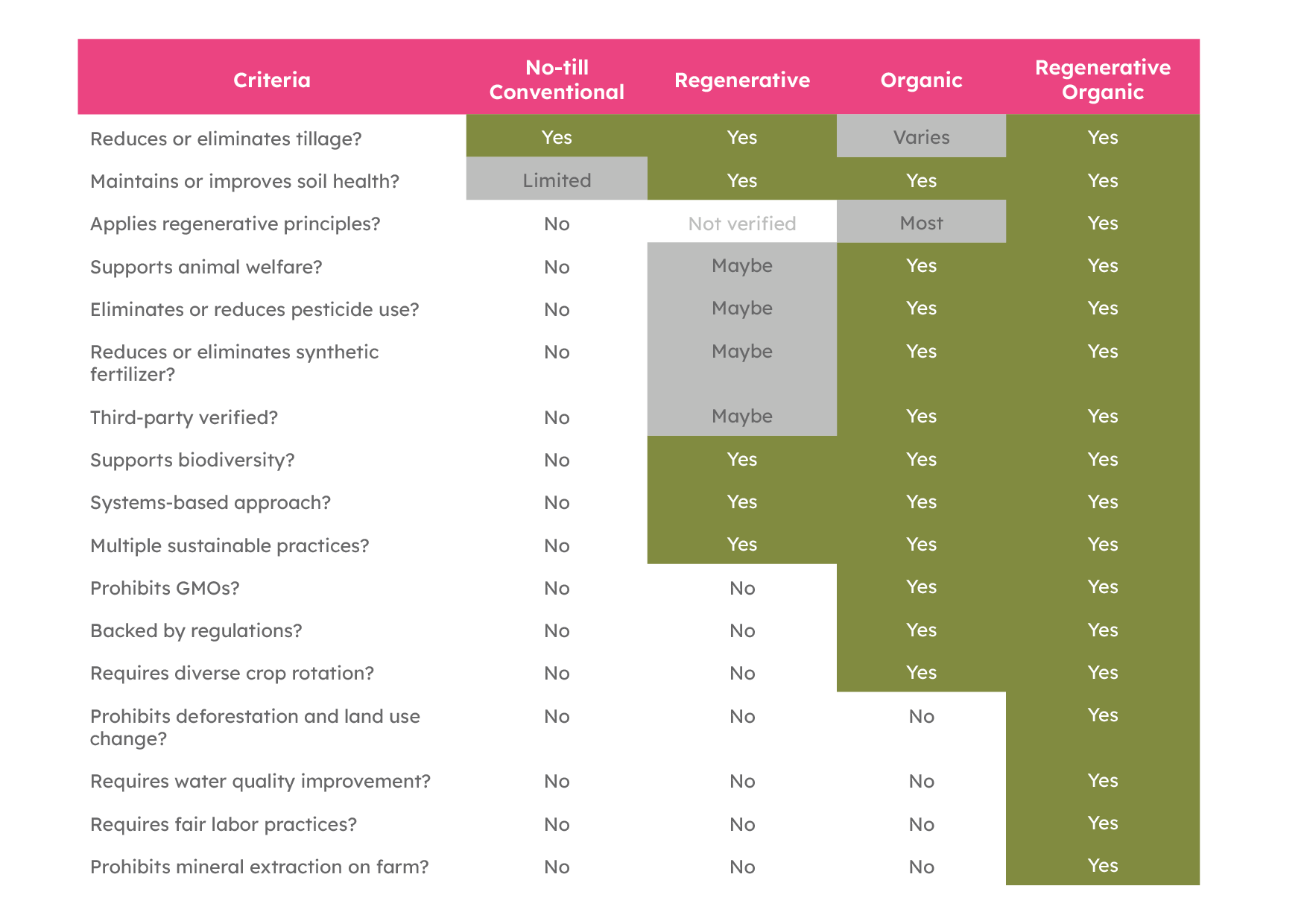
Regenerative operations, without certification, may still use GMOs and synthetic fertilizers and pesticides. There is no regulatory oversight of regenerative practices and claims for uncertified regenerative. There are no universal standards on how outcomes are measured. This absence of regulated standards for regenerative agriculture presents an opportunity for greenwashing, the practice of conveying a false impression that products are more environmentally friendly than they are.
Greenwashing activity risks the integrity of the regenerative movement and the value of farms that are truly regenerative. Regenerative operations must be transparent in their practices to avoid losing consumer trust. Some regenerative farms do seek certifications, including Regenerative Organic Certified, which also requires organic certification.
The most concerning greenwashing trend is the use of the regenerative halo to describe no-till conventional agriculture. While reducing or eliminating tillage applies one principle of regenerative agriculture, no-till conventional farming can increase the use of herbicides for weed control (FOE, 2025). In addition, no-till as a standalone practice can potentially increase fertilizer and pesticide run-off (Daryanto et al., 2020).
Tillage and Organic Production
One of the criticisms of organic production is that practices can include the use of tillage for weed control and the integration of plant residue. Tillage is often generalized into no-till, minimum tillage, reduced tillage, and conventional or intensive tillage. Reviews of agricultural practices and soil carbon identify that depth of tillage, frequency, intensity, and the type of equipment used all factor in the amount of physical disturbance to soil (OFRF, 2024.). Regenerative and organic standards also require preventing chemical and biological soil disturbance. Organic and regenerative practices, such as diversified rotations with deep-rooted plants, cover crops, and the use of organic fertilizers like green manure and manure, build soil organic carbon and support soil biology (Tiefenbacher, 2021).
Pesticides and Soil Biology
Soil is a living ecosystem. Soil microbiology, including bacteria and fungi, plays a critical role in the nitrogen and carbon cycles (Wu et al., 2023). Agricultural pesticides have been shown to alter the soil microbiome, including negatively impacting the bacteria that fix nitrogen (Walder et al., 2022). Pesticides have also been shown to harm beneficial soil invertebrates such as earthworms (Gunstone et al., 2021). Regenerative systems aim to reduce the chemical and biological soil disturbance from pesticides. Both organic and certified regenerative organic systems prohibit the use of synthetic pesticides.

Non-Regulatory Certifications
There is a myriad of non-regulatory certification programs for food labels. “Certified Naturally Grown,” for example, is a peer-to-peer farmer program. The claim is not backed by regulations or accredited certifiers as with organic certification. But, unlike generic use of the phrase “natural,” the program has published standards and peer review. Other non-regulatory certifications for food include Non-GMO Project Verified and Fair Trade. For regenerative systems, Regenagri, Regenified, and Certified Biodynamic are just a few of the non-regulatory certifications. The quality of such non-regulatory programs varies with their transparency, rigor of standards, and requirements for third-party verification.
What can Consumers Do?
The most important thing consumers can do is to engage in how their food is produced. Credible brands and farms will be transparent about their practices. Meaningful certifications include third-party verification and provide detailed standards. If you buy directly from farms, farm visits offer a great way to connect with how your food is grown. It sounds like a lot of effort. But there is great reward in the relationships and connections with the farmers and land where your food is produced. Consumer demand drives the market, sending signals to investors, policy makers, and finance that are essential for systems change. For those who are fortunate enough to have food choices, your daily decisions have a direct impact on the environment, your health, and the future of the food system for all.
References
L. Caesar, B. Sakschewski, L. S. Andersen, T. Beringer, J. Braun, D. Dennis, D. Gerten, A. Heilemann, J. Kaiser, N.H. Kitzmann, S. Loriani, W. Lucht, J. Ludescher, M. Martin, S. Mathesius, A. Paolucci, S. te Wierik, J. Rockström. (2024). Planetary Health Check Report 2024. Potsdam Institute for Climate Impact Research, Potsdam, Germany.
Daryanto, S., Wang, L., & Jacinthe, P. (2020). No-till is challenged: Complementary management is crucial to improve its environmental benefits under a changing climate. Geography and Sustainability, 1(3), 229–232. https://doi.org/10.1016/j.geosus.2020.09.003
Friedrich, T. (2005). Does No-Till farming require more herbicides? Outlooks on Pest Management, 16(4), 188–191. https://doi.org/10.1564/16aug12
Friends of the Earth. (2025). Rethinking No-Till: The toxic impact of conventional no-till agriculture on soil, biodiversity, and human health. https://foe.org/wp-content/uploads/2025/04/Report_No-Till_Report.pdf
GovFacts. (2025, April 30). What is Regenerative Agriculture? USDA Perspectives and Programs | GovFacts. GovFacts. https://govfacts.org/federal/agriculture/what-is-regenerative-agriculture-usda-perspectives-and-programs/
Gunstone, T., Cornelisse, T., Klein, K., Dubey, A., & Donley, N. (2021). Pesticides and Soil Invertebrates: A hazard assessment. Frontiers in Environmental Science, 9. https://doi.org/10.3389/fenvs.2021.643847
National Organic Program (2025). 7 CFR Part 205 -- National Organic Program. https://www.ecfr.gov/current/title-7/subtitle-B/chapter-I/subchapter-M/part-205?toc=1
Organic Farming Research Foundation. (n.d.) OFRF Organic is Regenerative message mapping - PUBLIC. Google Docs. https://docs.google.com/spreadsheets/d/1Vqb74zxacKXhUhh_9pzk63BcltdNIatFYdBQyMYRWvI/edit?gid=0#gid=0
Organic Farming Research Foundation. (2024, August 12). Not all tillage is created equal. Organic Farming Research Foundation. https://ofrf.org/news/not-all-tillage-is-created-equal/
Organic Trade Association, “Consumer Perception of USDA Organic and Competing Label Claims,” https://ota.com/resources/market-analysis/consumer-perception-usda-organic-competing-label-claims-report (paywall), Accessed 3 March 2025.
Regenerative Agriculture Initiative, California State University, Chico & The Carbon Underground. (2017). What is Regenerative Agriculture? https://regenerationinternational.org/wp-content/uploads/2017/02/Regen-Ag-Definition-2.23.17-1.pdf
Regenerative Organic Certified. (2023, May 11). Why Regenerative organic? - Regenerative Organic certified. https://regenorganic.org/why-regenerative-organic/
Tiefenbacher, A., Sandén, T., Haslmayr, H., Miloczki, J., Wenzel, W., & Spiegel, H. (2021). Optimizing carbon sequestration in Croplands: A synthesis. Agronomy, 11(5), 882. https://doi.org/10.3390/agronomy11050882
Walder, F., Schmid, M. W., Riedo, J., Valzano-Held, A. Y., Banerjee, S., Büchi, L., Bucheli, T. D., & Van Der Heijden, M. G. (2022). Soil microbiome signatures are associated with pesticide residues in arable landscapes. Soil Biology and Biochemistry, 174, 108830. https://doi.org/10.1016/j.soilbio.2022.108830
Wu, H., Cui, H., Fu, C., Li, R., Qi, F., Liu, Z., Yang, G., Xiao, K., & Qiao, M. (2023). Unveiling the crucial role of soil microorganisms in carbon cycling: A review. The Science of the Total Environment, 909, 168627. https://doi.org/10.1016/j.scitotenv.2023.168627